
Download the latest versions of our tools
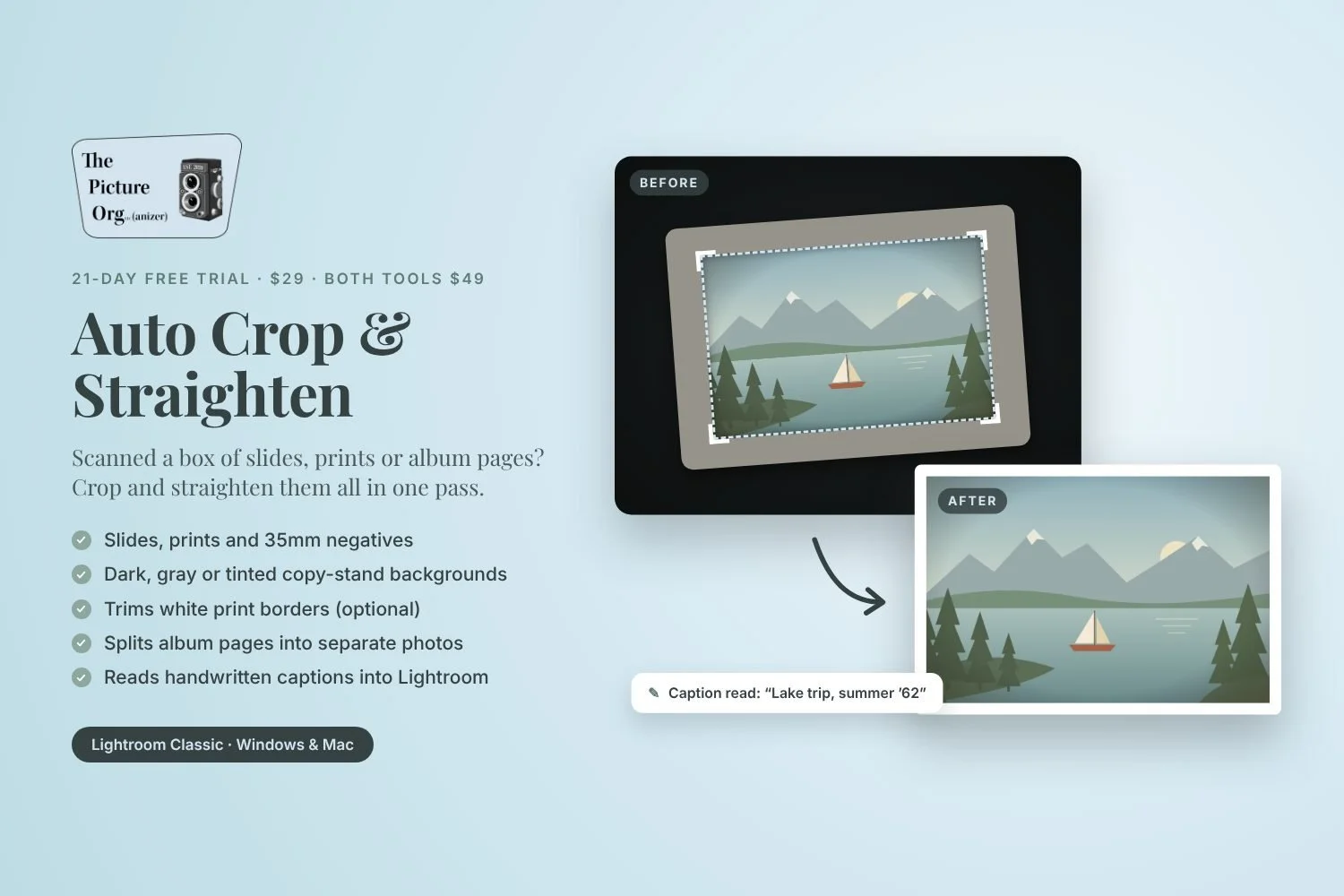
Auto Crop & Straighten: what's new
Version 0.5.3 11 October 2026
- Small prints on a wide dark surround (wallet-size school photos on black felt): the white border is now cropped off on every side. Before, the plug-in could take the print for a scan filling the frame and leave the border on one or two sides, or tilt the crop.
- Mounted prints on a light base board: a print in a wide card mount is found even when tape, a binder clip or a patch of glare on the board touches it, and the crop goes to the picture inside the mount. Before, these were not cropped at all.
- Card mounts and borders that are lit unevenly, getting lighter toward the picture, are trimmed instead of kept.
- A slide with a dark scene against one side of a dark mount is cropped like the rest of its batch, instead of as an "irregular shape".
- Fixed a rare "The trial has ended" message during the free trial, when Auto Crop and the Media Preservation Toolbox checked the trial at the same moment.
- The Buy a license button now goes to thepictureorg.com/tools.
Show full changelog
Version 0.5.2 11 October 2026
- New installers that put Auto Crop in Lightroom Classic's own plug-in folder, so Lightroom loads it by itself when it starts: no File > Plug-in Manager > Add step, and no administrator rights needed.
- Windows: a Setup program (PictureOrgAutoCrop-Setup download). It asks you to close Lightroom if it is open, replaces an earlier version, and adds a Start menu folder with the User Guide, the cheat sheet and Uninstall. Auto Crop is also listed in Settings > Apps for removing it.
- Mac: the Mac download now has "Install Auto Crop" and "Uninstall Auto Crop" next to the plug-in, plus a "Read Me First" with the steps. Right-click Install Auto Crop and choose Open; it copies the plug-in into place and clears the download mark so it runs without a security prompt. On an Intel Mac it offers the one-time setup.
- If you added Auto Crop before through File > Plug-in Manager > Add, remove that old entry in the Plug-in Manager after installing, or the menu appears twice. Your settings and license key are kept.
- The README, User Guide and cheat sheet explain both installers step by step; installing by hand through the Plug-in Manager still works as before.
Version 0.5.1 11 October 2026
- Album pages are no longer hidden: "Album pages (several photos on each)" is now always a choice under "The photos are of" in the Auto Crop dialog, with its TIFF and reading options. Nothing needs turning on in the Plug-in Manager.
Version 0.5.0 11 October 2026
- Auto Crop & Straighten is now paid software with a free trial. Every feature works free for 21 days on each computer, then for 7 more days with a reminder, then it stops cropping new photos until a license key is entered. Crops already made stay as they are.
- One license is for one person on up to 3 computers, with free updates within the major version (a version 1 key works for every 1.x release).
- New License section in File > Plug-in Manager: the days left or who it is licensed to, Buy a license, a box for your key with Enter key, and Remove license from this computer for moving to a new one. Keys are checked on your computer; nothing is sent anywhere. A bundle key also unlocks the Media Preservation Toolbox.
- When the trial has ended, Auto Crop offers Buy a license or Enter key before doing any work.
- The "Buy me lunch" buttons are gone. New license terms in LICENSE.txt; the README, User Guide and cheat sheet have a "Trial and license key" section.
Version 0.4.6 11 October 2026
- Album pages on a Mac: fixed "An internal error has occurred. ?:0: attempt to index a boolean value" after the photos were found. Lightroom gives back just "true" when it makes a virtual copy, not the copy itself; the plug-in now finds each new copy by its name ("Photo 1", "Photo 1 note") instead.
Version 0.4.5 11 October 2026
- Scans that fill the frame: flatbed and slide-scanner JPEGs with little or no surround. Before, the plug-in looked for a dark surround all round the item; with none, it could crop a strip off the picture as an "irregular shape", or find nothing. Now each side is checked for a straight dark band (the slide mount's window, the scanner lid's shadow) or the picture running right to the frame, and the crop is the frame less those bands.
- A slide whose picture is dark right against a narrow mount band (a dark wall, a forest, a coat) no longer has that band left in the crop.
- Print borders: a border that a scanner's shadow darkens toward the frame, or with a glint along the paper's edge, is now trimmed (it was left on one side). A thin sliver of white or cream border left along the frame of a closely cropped scan is trimmed too.
- Black felt or card lit unevenly: the brighter side of the felt no longer joins the print, so the print is found and cropped inside its white border.
- Album pages, reading the writing: writing on a print itself now also gets its own copy cropped to just the writing, named like a label's ("Photo 1 note"), for an easy spot check against the caption.
Version 0.4.4 10 October 2026
- Album pages, reading the writing: captions written on the prints themselves are now read too, not only separate labels. The text goes into that photo copy's Caption, ahead of any label's. Only writing on plain light paper counts, such as a white border or a pale studio backdrop; writing in the scene (a shop sign on a brick wall) is mostly left out, though a white street sign against a bright sky is read.
- Block capitals and clear handwriting are read well; small faint script is not. About 1 to 2.5 seconds more per photo.
Version 0.4.3 10 October 2026
- Album pages: new option "Read the writing on labels into the Caption field" (off). The writing on each label or note is read on this computer (nothing is sent anywhere) and put in the Caption field of the note's copy and of its photo's copy, with the keyword "Check caption" (under Auto Crop) so the drafts can be found and corrected. A photo copy's caption is only filled if nobody has written one there.
- The reader: on a Mac, Apple's own text reader (Vision, built into macOS); on Windows, or if Vision can't be used or reads nothing, RapidOCR with PaddleOCR's PP-OCRv6 small models on ONNX Runtime (about 30 MB of models).
- In testing on handwritten labels in block capitals, about three words in four were read correctly, at about half a second to a second per label. Faint cursive is mostly not read.
- The download grows: ONNX Runtime 1.23.2, PyYAML, the models, and on Windows the Microsoft C++ runtime files ONNX Runtime needs; on the Mac also PyObjC (for Vision).
Version 0.4.2 10 October 2026
- Album pages: label and note copies are no longer cut off. They are now cropped to the whole slip plus a small margin, never tighter; a slip tucked under a print is cropped up to the print's edge, so a sliver of the print may show rather than cut letters.
- A label the photo-splitting step had cut in two (a line of writing looked like a seam) is put back together as one note.
- A note goes with the photo just above it when there is one (captions are written under the picture); before, a label tucked under the next print down could be given to that print.
- New option "Crop inside rounded or mounted corners" (off): crops in from each side just far enough that no rounded corner, black photo corner or mount corner shows, at most 15% of the short side. For slides, prints and album pages, not negatives.
Version 0.4.1 10 October 2026
- Album pages: labels and slips of paper on the page (often with names or dates written on them) now get a copy too, named after the photo they are beside: "Photo 2 note" (a second one "Photo 2 note 2"). Each comes right after its photo, is cropped to the whole slip (no border trim, no rotation check), and is saved as a TIFF with the others when that option is on.
Version 0.4.0 10 October 2026
- Album pages (test feature, hidden until turned on in the Plug-in Manager): one photo or scan of an album page, on a black or dark page, a light page or grid, or a flatbed, can hold several prints. Choose "Album pages (several photos on each)" under "The photos are of". Each print found becomes a virtual copy of the page named "Photo 1", "Photo 2" ... (in reading order: rows from the top, left to right), cropped and straightened to that print; the page itself is left as it is. Optionally each is also saved as a 16-bit TIFF beside the page ("<page> - Photo 1.tif"), added to the catalog and stacked with the page.
- Prints that touch or overlap are split where one print's edge crosses the other (a step in brightness right across, an outline that jogs there, or a white border beside it). A straight line inside one print (a horizon, a fence rail, bricks) is not a split. Labels and captions on the page are found and left out, and so are tape, photo corners and slivers of the page edge. A pile of overlapping prints gives one copy per visible strip.
- On album pages a print border is trimmed only when it is found on all four sides; otherwise the whole print is kept, caption and all.
- Running again on a page (with "Replace crops already made") updates its existing "Photo" copies.
- About 3 to 10 seconds a page. Single photos, gray bases and negatives are unchanged.
Version 0.3.6 10 October 2026
- Gray and tinted backgrounds: photos taken on a copy stand's gray base board or a cutting mat (gray or green, grid lines and all) are now cropped. The item is whatever differs from the board, lighter, darker or in colour, measured against the board's own level across the frame (uneven light is allowed for). The grid lines are smoothed away, a print's soft shadow on the board counts as board, and the rectangle comes from the middles of the item's sides, so tape and fingers at its corners don't move it.
- Print borders: a border that narrows along a side (the picture printed a little crooked on its paper) is now trimmed to its widest point; a crease or uneven light across the border no longer stops the trim.
- Card mounts: with "Crop off white or cream print borders" on, a portrait's buff or cream card mount is trimmed to the picture. Untick the option to keep the mount and its imprint.
- Downloads are now named PictureOrgAutoCrop-Win-<version>.zip and PictureOrgAutoCrop-Mac-<version>.zip.
Version 0.3.5 10 October 2026
- Mac (Apple silicon, macOS 13 or later): a separate Mac download carries its own Python 3.12 with NumPy, OpenCV and rawpy, as the Windows download does. Nothing to install: no python.org, no Setup-Mac.command, no Terminal. On its first run the plug-in clears macOS's "downloaded from the internet" mark on its own folder so the built-in Python can run without a security prompt.
- Intel Macs, and Macs older than macOS 13, fall back to Setup-Mac.command as before (the message says so).
- NOTICE.txt lists the Mac components; licenses in python-mac/licenses.
Version 0.3.4 10 October 2026
- Mac: the "Run Setup-Mac.command" message, the README, User Guide and cheat sheet now say how to reach it. Finder shows the .lrplugin folder as a single item, so the file couldn't be found: right-click the plug-in, Show Package Contents, right-click Setup-Mac.command, Open.
Version 0.3.3 10 October 2026
- Undoes the 0.3.2 raw-file change: Lightroom measures these crops on the whole sensor after all, so raw crops are back exactly where 0.3.1 put them.
- Negatives: a side whose edge shows along only part of its length (a dense sky above shadows) is now found from the whole side at once, rather than guessed from the sprocket holes.
- Negatives: the sprocket holes are measured to a fraction of a pixel and fitted as one straight row, so sides placed from them land closer. Sides placed from the holes no longer get extra trim.
- Negatives: 1 pixel less trim inside every edge (the edges are sharp; the crop still sits inside the bright line at the frame edge).
Version 0.3.2 10 October 2026
- Raw files (DNG, NEF and others): crops moved to allow for the raw file's default crop area. (Undone in 0.3.3.)
- New troubleshooting row in the User Guide and cheat sheet: a photo with an earlier edit can look shifted; Develop > Reset fixes it.
Version 0.3.1 10 October 2026
- Negatives: edges that can't be seen are now placed from the sprocket holes. A camera moves the film exactly 8 holes per frame and holds it at a fixed height, so on one roll every frame sits in the same place relative to the holes. Frames in the selection whose edges show give that place; the others use it. Fixes "no frame edges found" on frames whose picture is nearly clear along two sides.
- Negatives: the edge finder looks past a neighbouring frame at the side of the capture, and finds low-contrast edges that could leave the sprocket-hole strip in the crop.
- Negatives: a side with nothing to go on is placed from the 3:2 shape of the frame, or on the sprocket side just inside the holes, before falling back to the capture's edge. Sides placed this way get 2 pixels more trim.
- User Guide and cheat sheet: where to find autocrop-log.txt (type %TEMP% in File Explorer's address bar).
Version 0.3.0 10 October 2026
- New: 35mm film negatives. In the options dialog, "The photos are of" > "35mm film negatives (in a carrier)". Edges are found where the picture gets darker than the clear film base (measured beside the sprocket holes), so the crop leaves out the rebate, sprocket holes and frame gaps, and is straightened to the frame. Frames from one camera are the same size: when three or more frames in the selection agree, that size places any side that can't be seen (a thin, nearly clear part of the picture), else the 3:2 shape is used. A side that runs off the capture is cut at the capture's edge. Crop before inverting.
- Print borders, Crop closer and rotation flags are not used for negatives (greyed out in the dialog).
- Documentation updated: User Guide section 11 (negatives; later sections renumbered), cheat sheet, README, design document.
Version 0.2.12 10 October 2026
- Rotation flags now follow how Lightroom shows the photo. The helper used the rotation saved in the file (or its sidecar), which can differ from Lightroom's own, so some sideways photos were not flagged. The plug-in now passes Lightroom's rotation to the helper (it falls back to the file's if Lightroom doesn't give one).
- autocrop-log.txt now gets one line per run saying for how many photos Lightroom's rotation was used.
- "Buy me lunch" buttons, as in the Media Toolbox: in the options dialog and in the Plug-in Manager panel.
Version 0.2.11 10 October 2026
- Fewer false rotation flags from faces: a sideways face must now be found at three different sizes of the picture. The face finder sometimes sees a faint "face" in a pattern, such as aircraft panels, at one size only. Real faces are found at every size. No slowdown: the extra sizes are only checked when a face turn is in view.
- New one-page cheat sheet: docs\Auto-Crop-Cheat-Sheet.html and .pdf.
- Documentation brought up to date: README, User Guide (troubleshooting for false flags and the empty log, new Planned section) and design document.
Version 0.2.10 10 October 2026
- Slides with a pale sky or sand along an edge no longer lose it to the "print border" trim. A real border ends in a straight line along the side; sky and sand end wherever the scene does, and a blue sky is never taken for a border. Prints with real borders are trimmed as before.
- A dark object in the picture that runs right up to an edge (a table leg, say) no longer pulls that whole side in: when part of the side agrees on one straight edge further out and the rest scatter inside it, the straight edge is used.
Version 0.2.9 10 October 2026
- Photos given an Auto Crop keyword (Check rotation or Irregular shape) also get the purple colour label. Labels are never removed, since one may be your own.
- Orientation: a blue, smooth sky down one side now flags the photo.
Version 0.2.8 10 October 2026
- Photos cut to a circle, an oval or a ragged shape are recognised and cropped to the rectangle around the whole photo, so none of the photo is cut off. They get the keyword "Auto Crop > Irregular shape", and the summary says how many there were. Ordinary prints and slides are unchanged.
Version 0.2.7 9 October 2026
- New option "Crop closer to the edge" (off by default). Where the picture is dark against an edge, the crop goes to the outer end of the edge's soft fall-off, and no extra trim is used. Keeps detail that runs right to a slide mount. A thin dark line may show along some edges, so it is meant for the photos that need it.
Version 0.2.6 9 October 2026
- Soft slide edges: where the mount's shadow dims the last few pixels of picture, those pixels are now kept. A dark band near the mount's own darkness is still cropped off.
- Along each edge, the bright stretches count most, since a dark part of the picture against the edge makes the edge look further in than it is.
Version 0.2.5 9 October 2026
- Added LICENSE.txt, NOTICE.txt, this change log, a User Guide (docs folder, Markdown and HTML) and a design document (docs folder, Word). No change to how photos are cropped.
Version 0.2.4 9 October 2026
- When a slide's picture window isn't square (the camera slightly off square to the slide), the crop trims a sliver rather than show any border.
- The straighten angle is also checked for the one that keeps the most picture inside all four edges.
Version 0.2.3 9 October 2026
- The edge check from 0.2.2 pulled some sides in too far. It now goes by most of each side rather than its worst stretch, and can move a side out slightly where the picture clearly runs further.
- The extra trim inside the edge is now 0.15% by default (was 0.3%). Saved settings from earlier versions are replaced by the new default once.
Version 0.2.2 9 October 2026
- Each edge is checked in 16 short stretches along its length and moved in where the picture's edge is wavy or slightly crooked, so no black shows.
Version 0.2.1 9 October 2026
- Logo and a short description in Lightroom's Plug-in Manager.
- Orientation check also looks for a horizon running top to bottom.
- Orientation is judged as the photo is shown (the file's own orientation tag, or an .xmp sidecar for raw files).
Version 0.2.0 9 October 2026
- Slides: edges found on the camera's linear (raw) brightness, in stops, so dark pictures are not mistaken for the surround; mount glow and dark bands are passed over.
- Batch check: photos taken in the same holder are compared, and a side that disagrees with the rest is moved to the agreed place when the photo has a clear edge there.
- White or cream print borders on two sides are both trimmed.
- Orientation flags: keywords "Check rotation - turn left / turn right / upside down" under "Auto Crop", never included in exports. Nothing is turned automatically.
- One helper run for the whole selection, with a progress bar per photo; Cancel stops after the current photo.
- Windows bundle moved to OpenCV 4.14 (OpenCV 5 no longer includes the face detector).
Version 0.1.0 9 October 2026
- First test: Lightroom Classic plug-in with a Python helper. Crops and straightens photographed prints, magazines and documents on a dark background; optional print-border trim (on by default). Windows Python bundled; Mac uses its own Python 3 with Setup-Mac.command.
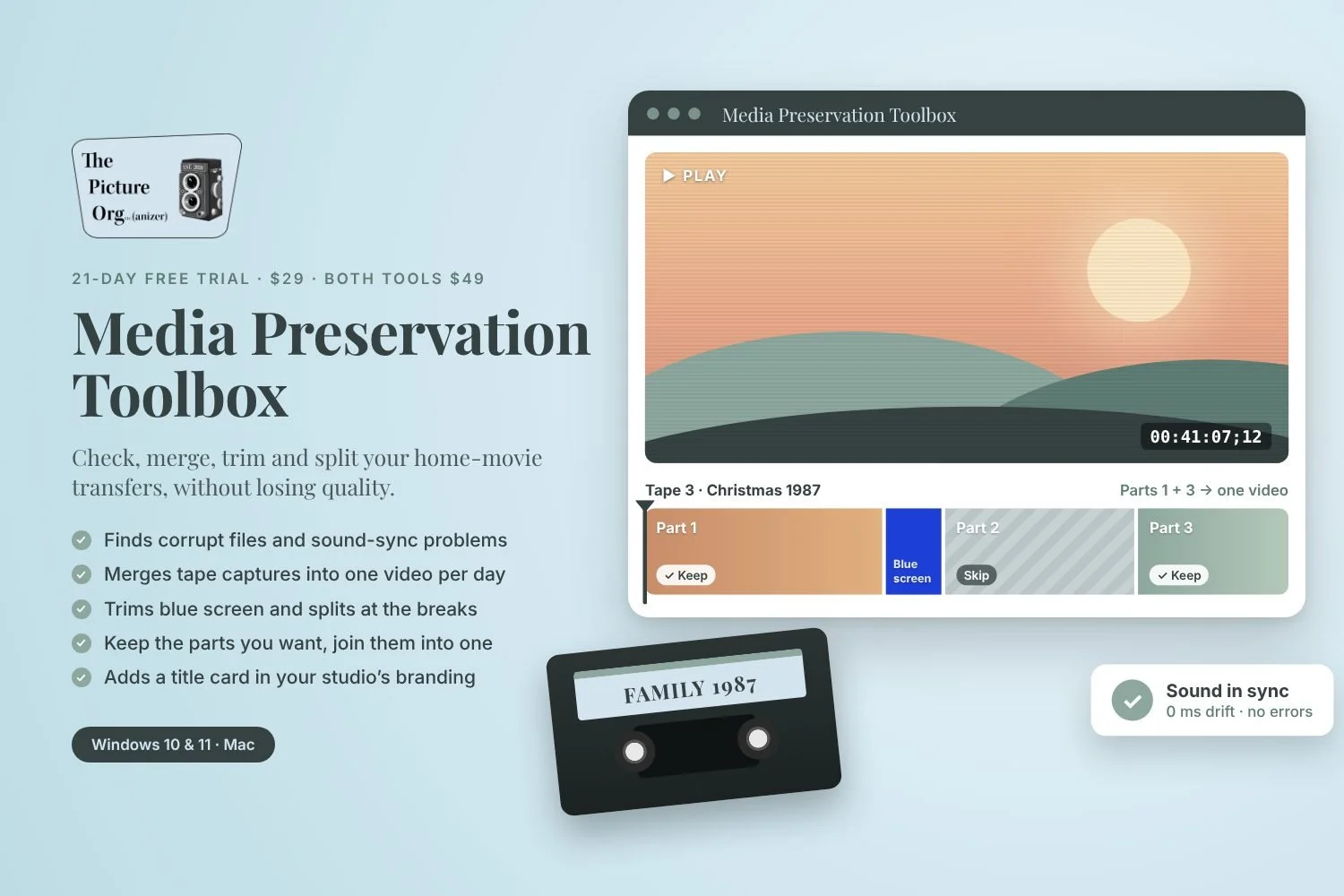
Media Preservation Toolbox: what's new
Version 1.11.1 11 October 2026
Changed
- The Setup program asks who will use the toolbox. "Anyone who uses this computer" (the default) installs it in C:\Program Files\The Picture Org\Media Toolbox, like other Windows programs, with Start menu and desktop icons for every account; Windows asks for an administrator's permission. "Only for me" installs in your own account as before, with no permission needed.
- Your own files are no longer kept in the toolbox's folder. Settings, studio branding, Reports and Logs are kept in your own account: %LOCALAPPDATA%\PictureOrg\MediaToolbox on Windows, ~/Library/Application Support/PictureOrg/MediaToolbox on a Mac. Each person who uses the computer has their own, and installing, updating or uninstalling leaves them alone. The first time 1.11.1 opens it copies these files from where earlier versions kept them; the originals are left where they were, so nothing is lost. Settings in both dashboards shows the folder under "Your Files", with an Open Folder button, and the Start menu has "My Reports and Logs".
- If an earlier version is installed only for you and you now install for everyone, Setup removes the old copy's Start menu and desktop icons, so there aren't two, and offers to remove its program files, keeping your settings, branding, Reports and Logs.
- Check for ffmpeg / PowerShell Updates, with the toolbox installed for everyone: checking works as before; installing asks Windows for an administrator's permission and shows its progress as usual. If permission is refused, nothing is changed and the log says why. A downloaded PowerShell is switched in at the next start, after a short message and one more permission prompt.
- Mac: the package is now an app, Media Toolbox.app, with "Install Media Toolbox.command" (copies it into Applications and clears the download mark) and "Uninstall Media Toolbox.command" (removes the app and keeps your files and license key). The app starts the browser dashboard without a Terminal window; the dashboard stops by itself 10 minutes after its last page is closed, when nothing is running.
Docs
- README, User Guide (where your files are kept, installing for everyone or only for you, the Mac app, updating) and Cheat Sheet.
Scripts: Update-Toolbox 1.1.0, Remove-BlueScreen 1.2.9, Merge-VideosByDate 1.3.2, Show-BreakPlayer 1.0.9; new ToolboxPaths.ps1 1.0.0.
Show full changelog
Version 1.11.0 11 October 2026
Added
- A 21-day free trial with every feature, then a license key. The donation link at the bottom of both dashboards is replaced by the license area: the days left in the trial (or "Licensed to" and your name), Buy a license, Enter key... and, once licensed, Remove license from this computer (it asks first, and says when a bundle key also comes off Auto Crop & Straighten). Keys are checked on the computer itself; nothing is sent anywhere. They are kept in your user account, so they survive upgrades. One license is for one person on up to 3 computers, and updates are free within the major version.
- For 7 days after the trial the toolbox keeps working, and a reminder with Buy a license and the key box opens each time the dashboard opens. After that the dashboard still opens and the license area works, but Execute Task, the player, the preview copy and the scene search ask for a key first. Check for ffmpeg / PowerShell Updates always runs.
- Run from the command line, the tool scripts check too: after the trial they print the reason and stop with exit code 9 before doing anything; during the reminder days they print a warning and carry on.
Changed
- LICENSE.txt is now a paid license (21-day trial, then a license key; one person on up to 3 computers; updates free within the major version). The copyright, no-modification and third-party terms are as before.
Docs
- README, User Guide (new section 21, Trial and license key), Cheat Sheet and Design Document.
Scripts: Remove-BlueScreen 1.2.8, Merge-VideosByDate 1.3.1, Split-VideoAtMarks 1.1.2, Convert-AudioToAac 1.0.1, Test-Mp4Integrity 1.3.3, Find-SceneChanges 1.0.5, Set-MergedVideoDate 1.0.2, Sync-MediaManifest 1.3.2, Show-BreakPlayer 1.0.8; new PictureOrgLicense.ps1 1.0.0.
Version 1.10.15 10 October 2026
Fixed
- A PowerShell process could still be left behind after closing the dashboard (reported after 1.10.14). The dashboard, the player window and the browser dashboard now end their own process outright once settings are saved and jobs stopped, instead of asking PowerShell to quit (which can wait on shutdown handlers). The player leaves its result for the dashboard in a small file beside the break points.
Added
- Logs\dashboard_trace.log lists the other pwsh.exe processes running when the dashboard starts, with their command lines, so any left behind (by the toolbox or another program) can be traced.
Scripts: Show-BreakPlayer 1.0.7.
Version 1.10.14 10 October 2026
Fixed
- Closing the dashboard, the player window or the browser dashboard could leave a hidden PowerShell (pwsh.exe) running, and they added up each time the toolbox was opened and closed. PowerShell waits for every leftover thread before it quits (Windows' video playback or a job that is still stopping can leave one), so each one now ends its process outright once it has saved its settings and stopped its jobs.
Scripts: Show-BreakPlayer 1.0.6.
Version 1.10.13 10 October 2026
Added
- Mac package, MediaToolbox-Mac-1.10.13.zip: the toolbox with its own PowerShell 7.6 and ffmpeg 9 for Apple silicon Macs, so nothing needs installing. Double-click Launch.command; the first time, allow it under System Settings > Privacy & Security > Open Anyway (the toolbox isn't registered with Apple). Intel Macs use PowerShell and ffmpeg from Homebrew, as before.
Fixed
- Split with Join: kept parts that follow each other (nothing skipped between them) now run on with no fade. Before, every break between two kept parts got a fade, even where nothing was cut.
- The Windows dashboard now deletes player preview copies and scene scans older than a week from the temp folder, as the browser dashboard already did (they piled up when only the Windows dashboard was used).
- Browser dashboard: Find Scene Changes falls back to Fewer, the default, rather than Normal.
Docs
- README, User Guide (sections 1, 2, 13, 14, 17 and others) and Cheat Sheet: the Mac package, the Setup program for upgrading and uninstalling, the Reports and Logs folders, the full folder layout and the AAC tool.
- Script help, tooltips and code comments checked against the code and brought up to date (dashboard versions, report names, log paths, the Output Folder tooltip per tool, player parameters and exit codes).
Scripts: Remove-BlueScreen 1.2.7, Split-VideoAtMarks 1.1.1, Find-SceneChanges 1.0.4, Show-BreakPlayer 1.0.5, Update-Toolbox 1.0.1.
Version 1.10.12 9 October 2026
Added
- Windows Setup program, MediaToolbox-Setup-1.10.12.exe, as an easier alternative to the zip. Installs for the current Windows account without administrator rights (in %LOCALAPPDATA%\Programs\Picture Org Media Toolbox), with Start menu shortcuts, an optional desktop icon, and an entry in Settings > Apps. Installing a newer version over an older one keeps settings, studio branding, Reports and Logs; uninstalling keeps them too unless asked.
- The dashboard doesn't offer to make a desktop shortcut when it was installed with the Setup program.
Version 1.10.11 9 October 2026
Added
- Split player (both): a Result line under the parts list says exactly what the split will make before you run it: each file and its name with the times it covers, the stretches left out, or, with Join ticked, the one joined video and its length. The Windows dashboard tells the player whether Join is ticked.
Docs
- User Guide section 19 starts with "How parts are made, skipped and joined": six plain rules (a part runs from its break to the next; skipped parts are removed; every kept part is its own file, named or not; delete a break to merge two parts; Join makes one video; nothing is made until Execute Task) and a worked newscast example. Cheat sheet updated to match.
Scripts: Show-BreakPlayer 1.0.4.
Version 1.10.10 9 October 2026
Changed
- Find Scene Changes: Fewer now suggests a few more breaks than it first did (changes of 12 and up; it was 15 before 1.10.9 and 25 in 1.10.9). Normal (8) and More (5) are unchanged.
Scripts: Find-SceneChanges 1.0.3.
Version 1.10.9 9 October 2026
Fixed
- Windows split player: the Frame buttons (and Left / Right) went to the start of the video. The position is now noted before pausing and kept by the player while paused, instead of being read back from Windows' player, which can report 0 just after pausing. If the two disagree, Logs\dashboard_trace.log says so.
- Windows split player: after clicking the slider or the picture, the arrow keys could stop working (keyboard focus went nowhere). Clicking anywhere but a text box now gives the keys back to the player; Esc leaves a text box. Browser player: ticking Keep no longer takes the keys away.
Added
- Start and End buttons at the two ends of the player's button row, and the Home / End keys, in both players.
- Windows player: each part's tooltip says where it runs, from its break to the next one.
Changed
- Find Scene Changes: Fewer is stricter (changes of 25 and up, was 15). Reversed in 1.10.10.
Scripts: Show-BreakPlayer 1.0.3, Find-SceneChanges 1.0.2.
Version 1.10.8 9 October 2026
Added
- Split tool: keep only some parts. The Windows player's list now has a Start row (the part before the first break) and, on every row, a Keep tickbox and a name box, so you no longer have to type "skip" (the browser player already had these). Untick Keep to leave a part out, such as a blue screen or a commercial.
- Split tool: "Join the kept parts into one video" (-Join on the command line). Instead of a file per part, the parts you keep go into one video, "<name> - Edited.mp4", with a quick fade where a part was left out. Example: a newscast where you keep the segments before and after a commercial and drop the rest of the tape.
Changed
- Find Scene Changes: Fewer (sharpest changes only) is now the default, in both players and Find-SceneChanges.ps1.
Scripts: Remove-BlueScreen 1.2.6, Split-VideoAtMarks 1.1.0, Find-SceneChanges 1.0.1, Show-BreakPlayer 1.0.2.
Version 1.10.7 9 October 2026
Fixed
- Blue-screen tool missed short blue flashes in the middle of a tape. A flash of blue can last only about half a second (flat blue, silent), and blue had to last at least 1 second to be cut. The shortest blue now cut is 0.3 s (-MinBlueSeconds). Blue that is still too short is now listed in the log as "[KEEP] Blue but shorter than ..." instead of being passed over silently.
Scripts: Remove-BlueScreen 1.2.5.
Version 1.10.6 9 October 2026
Fixed
- Windows split player still closed while clicking through breaks. Its exit code (0x80131623) is WPF ending the program on an internal check, not the video decoder. The likely trigger: the break-point text box was selected, scrolled and unfocused from code while a click in it was still being handled. Now the breaks are shown in a separate list beside the text box (click one to go to it; the one shown is highlighted), and the text box is never changed from code during a click. Names typed after "# suggested" are tidied once you've left the box.
- Preview copy (after the player closed): the picture area now says the copy is being made, with a percentage and the time left, and the break list, markers and Find Scene Changes work while it is made. If the copy fails, ffmpeg's reason is shown and logged.
Scripts: Show-BreakPlayer 1.0.1.
Version 1.10.5 9 October 2026
Fixed
- Windows dashboard: the whole dashboard could close while clicking through break points in the split player. The trace log showed the process ending with no error at all, which is Windows' video playback failing inside the player (no script can catch that). The player now runs as its own program (Show-BreakPlayer.ps1 1.0.0), so only the player closes. Its break points are saved as you go and come back to the dashboard either way. After such a close, the dashboard offers to reopen the player on the small preview copy, which Windows plays more reliably.
- While the player is open, Find / Mark Breaks... shows "Player is open...", and Execute Task for the split tool asks you to finish in the player first.
Version 1.10.4 9 October 2026
Changed
- CSV reports now go in a Reports folder and logs (dashboard_debug / _trace / _error, web_debug) in a Logs folder, both next to the scripts. On start, the dashboards move reports and logs left beside the scripts by earlier versions into these folders.
Fixed
- Windows split player: clicking quickly through the breaks (markers, list lines, N / P) could make the player stop working. Jumps are now spaced at least 150 ms apart; only the latest one is applied, so the frame shown still ends up on the last break clicked. Opening and closing the player is now written to the trace log, so a crash there can be told apart from one elsewhere.
Version 1.10.3 9 October 2026
Changed
- Both dashboards: Output Folder now sits right under Target Media (shown for the merge, blue-screen, split and AAC tools), and File Prefix sits under the Title / Family name row, next to the other naming choices.
Version 1.10.2 9 October 2026
New
- Settings button (top right, both dashboards). FFmpeg Binary and Studio Branding (studio name, title card colour, logo) moved there from the main window, which now shows only what changes from job to job. Done or Esc goes back. If a job can't find ffmpeg, the Settings window opens by itself.
- Split tool: the player button is now "Find / Mark Breaks..." (was "Mark in Player..."), since it's also where the suggested breaks come from. When the player opens with no break points yet, Find Scene Changes starts by itself (Normal sensitivity); you can mark your own while it runs. The empty Break Points hint says the same.
Fixed
- File Prefix (and other fields) sometimes came back from a couple of runs ago. All windows of a dashboard share one settings file, and a second window, or one left minimized to the tray, wrote all of its older values back when it closed or changed anything. Each window now writes only the fields changed in it. The browser dashboard also saves each field as it changes, not only when a job starts.
Version 1.10.1 9 October 2026
New
- Split player, both dashboards: a row of markers under the slider / timeline, one per break (yellow = suggested, blue = yours, white = the break shown). Click one to go straight to that break.
- The break the frame shown belongs to is highlighted in the list, so after N, P or a click you can see which one you're on.
- Click a break in the list to go to it: a single click on its line (Windows; was a double-click) or anywhere on its row (browser). In Windows a click on the time also gives the keys back to the player.
Changed
- Windows player: a name typed after "# suggested 23" is moved in front of the note (it used to be read as part of the note and ignored), and Remove Suggestions no longer removes a suggestion that has been named that way.
Version 1.10.0 8 October 2026
New
- Convert-AudioToAac.ps1 (Convert-AudioToAac 1.0.0), in both dashboards: converts the sound in videos to AAC, whatever its format (PCM, FLAC, AC-3, MP2, MP3, ALAC, Opus, DTS ...). The picture is copied untouched; tracks already AAC are copied; files are not renamed (MP4, M4V and MOV keep their extension; AVI, MKV, MTS and the like become MP4, or MOV for DV). Each new file is checked before it is used: the picture must be identical (SHA-256 of every packet, or of every decoded frame for AVCHD), every sound track must decode cleanly, start in step with the picture and be as long as before, and a copy to another drive or the NAS must match by SHA-256. New files go into an AAC folder, or with "Replace the originals" each takes its original's place and the original is deleted, only after every check has passed (the dashboards ask first, and the option isn't remembered). Report: aac_report_*.csv. User Guide section 20; on the Cheat Sheet.
Fixed
- Browser dashboard: rows hidden for the update tool (such as the branding colour) could still show.
Version 1.9.6 8 October 2026
Fixed
- Windows dashboard: the progress label said "% of this day" for every tool. It now says "of this file" for the blue-screen, split and other tools, and "of this day" only when merging.
Version 1.9.5 8 October 2026
New
- One-page Cheat Sheet (docs\Media-Toolbox-Cheat-Sheet.html and .pdf, letter size): starting the toolbox, the five steps of every job, which tool to use, the key options, file dates and names, player keys, checking suggested breaks, reports and logs, and common fixes. Linked from the top of the User Guide and the README.
Changed
- User Guide: the dashboard_trace.log description now matches 1.9.2 (keeps history, records jobs and crashes).
Version 1.9.4 8 October 2026
Changed
- Blue-screen and split tools: with File Prefix blank, the prefix comes from the family name, as for merging ("The Smith Family" gives "Smith_"). The family name is now passed whatever the Title setting; it is still shown only on a title card.
Scripts: Remove-BlueScreen 1.2.4, Split-VideoAtMarks 1.0.3.
Version 1.9.3 8 October 2026
New
- File Prefix for the blue-screen and split tools (-Prefix), as for merging: "Smith" gives "Smith_1995-03-26.mp4" or "Smith_1995-03-26 - Part 01.mp4". Blank keeps the original name. The title card and the date still come from the original name.
Scripts: Remove-BlueScreen 1.2.3, Split-VideoAtMarks 1.0.2.
Version 1.9.2 8 October 2026
Changed
- Windows dashboard: dashboard_trace.log now keeps earlier sessions (the newest 2000 lines) instead of starting empty each time, marks each line with the window's process number, and records when a job starts and ends. If the dashboard closes unexpectedly, the error that ended it (even one on a background thread) and the process exit are written there first, so the cause can be found after reopening.
Version 1.9.1 8 October 2026
Fixed
- Blue-screen and split tools: an unexpected error on one file (for example a file locked or removed on a network share, or a permission problem) stopped the whole batch. Now that file is marked FAIL in the log and the CSV report, with the error, and the batch carries on with the next file.
Scripts: Remove-BlueScreen 1.2.2.
Version 1.9.0 8 October 2026
New
- Find Scene Changes (Find-SceneChanges 1.0.0), in the split tool's player in both dashboards: reads the whole video once and suggests a break wherever the picture changes suddenly (the camcorder stopped and started, or one recording taped over another). Suggestions land on exact frames and are marked "suggested" for you to check before splitting. Three settings: Fewer, Normal, More; changing it is instant after the first search. Camera flashes and brief dropouts in the middle of a scene are ignored; static between two recordings counts as one change, with the break on the first clean frame after it.
- Player: Break > and < Break (keys N and P) jump from break to break; Move Nearest Break Here (H) nudges a break that is a frame or two off; Remove Suggestions clears the ones you haven't named or moved.
- Break-point lines can carry a note after " #" (Find-SceneChanges writes "# suggested 23").
Fixed
- Windows player window: times were rounded to whole seconds, so frame stepping and Add Break Here would not have worked.
Scripts: Find-SceneChanges 1.0.0, Remove-BlueScreen 1.2.1, Split-VideoAtMarks 1.0.1.
Version 1.8.0 8 October 2026
New
- Split a video at break points (Split-VideoAtMarks 1.0.0): choose the new tool, pick a video, and scrub through it in a player (a window in the Windows dashboard, part of the page in the browser dashboard). Step frame by frame, add a break wherever a new video should start, name the parts, leave out the ones you don't want. Each part becomes its own MP4 ("<name> - 02 Birthday party.mp4") in a Split folder. Breaks land on the exact frame; with Smart cut only the frames up to the next keyframe are re-encoded, and the sound is cut at the same point.
- Videos the player can't play (DV AVI, MPEG-2) get a small preview copy to mark on, frame for frame the same as the original. The original is what gets split.
- Break points can also be typed or pasted (one per line, "00:12:30.5 Birthday party"; "skip" leaves a part out) or given on the command line, and are saved next to the parts as <name>.marks.txt.
- Blue-screen tool: "Split into separate videos at the blue screens" (-Split). Each stretch of picture between the blue screens becomes its own video ("<name> - Part 01.mp4"), cut like a join, with no fades. Moments shorter than 2 seconds between two blue screens are left out (-MinPartSeconds).
- Split parts are dated from the original's date plus the part's start time, so they sort in order. With a title card, each part gets one ("Part 2 of 5", or the part's name as the title).
Changed
- Blue-screen tool: a split, or several parts, share one copy pass of the source, so a long tape on a network share is still read only once.
Scripts: Remove-BlueScreen 1.2.0, Split-VideoAtMarks 1.0.0.
Version 1.7.0 8 October 2026
New
- Title card or overlay for the merge and blue-screen tools (Title: No title / Title card / Overlay text). The card is 4 seconds before the video with the logo, family name, title, date and "Preserved by <studio>"; the sound is delayed by exactly the card's length, so sync is unchanged. The overlay shows the title and date at the lower left of the first 4 seconds. For the blue-screen tool the title comes from the file name; for merging it is the day's date.
- Family name (optional), shown on the title card.
- Merge: with File Prefix blank, the file prefix comes from the family name ("The Smith Family Archives" gives Smith_, "The Smith-Jones Family" gives Smith-Jones_).
- Studio Branding: studio name, card colour and logo, saved in branding.json, so other studios can use the toolbox under their own name. The dashboards show the chosen logo too.
- Playfair Display bundled as the title font (or put your own in assets\fonts).
- Donationware license (LICENSE.txt): free to use, not to modify or resell. "Buy me lunch" link in both dashboards.
- README.txt (installing, upgrading, uninstalling) and this change log.
Changed
- New name: Picture Org Media Preservation Toolbox (was Media Automation Toolbox / Media Operations Dashboard).
- Copyright notices in every script and launcher; NOTICE.txt credits FFmpeg, PowerShell and Playfair Display, and the FFmpeg license text is included in bin.
- Bundled PowerShell updated to 7.6.6.
- User Guide: new introduction and requirements; Design Document brought up to date.
Fixed
- The Family name box could only be typed in when Title was set to Title card.
Scripts: Merge-VideosByDate 1.3.0, Remove-BlueScreen 1.1.0.
Version 1.6.0 8 October 2026
New
- Update ffmpeg and PowerShell: "Check for ffmpeg / PowerShell Updates" in the tool list (Update-Toolbox 1.0.0). Downloads are checked against their published checksums; the old versions are kept.
- Several dashboard windows can run jobs at the same time, each with its own log and reports.
- Merge: with Recursive Scan, each sub-folder is treated as its own tape with its own Merged folder.
- Time taken for each file or day, in the log and in a new Time column in the reports (the blue-screen report also breaks it down by step).
- Blue-screen tool: a date at the start of the file name (e.g. 1998-10-25 Halloween.mp4) is written into the output and onto its file dates. Files with no blue get a dated, untouched copy.
Changed
- Blue-screen tool is much faster on network drives: it reads only what it needs and writes the output once.
- Blue-screen edges are exact to the frame.
Scripts: Merge-VideosByDate 1.2.1, Remove-BlueScreen 1.0.4, Update-Toolbox 1.0.0.
Version 1.5.0 8 October 2026
New
- Trim Blue Screen tool (Remove-BlueScreen): removes the VCR blue screen from the start, end and middle of tape captures. Smart cut re-encodes only around each cut and copies the rest untouched; Full re-encode and Copy only are also available.
- Automatic GPU encoding (NVIDIA, Intel or AMD) when available, with the CPU as fallback.
Version 1.4.0 7-8 October 2026
New
- Merge by date tool (Merge-VideosByDate): one MP4 per recording day from AVI/DV captures, NTSC or PAL, dated from the day's first clip. Preview only is on by default.
- Set-MergedVideoDate (command line): dates MP4s that were merged in other software.
Fixed
- A DV clip with no aspect-ratio flag is treated as 4:3 instead of being squeezed.
- A clip that can't be read is left out with a warning; the rest of the day is still made.
- Tape dropout messages are summarised as one line per day.
- A prefix such as "Smith" gets an underscore, giving Smith_2001-12-01 17.08.25.mp4.
- Validator (Test-Mp4Integrity 1.3.2): the harmless "UDTA parsing failed" warning no longer fails a file.
Version 1.3.1 1 October 2026
Fixed
- Browser dashboard: the folder and file choosers open in front of the browser (macOS asks once for permission to control System Events). The Windows chooser got the same fix.
Version 1.3.0 1 October 2026
New
- Browser dashboard (MediaToolboxWeb.ps1) for macOS and Windows, alongside the Windows dashboard, with Launch.command (Mac) and Launch-Web.bat (Windows). It keeps its own settings file.
Version 1.2.2 1 October 2026
Changed
- macOS "._" metadata files are skipped instead of being reported as corrupt video.
Version 1.2.1 1 October 2026
New
- Version number shown in the bottom-right corner of the dashboard.
Version 1.2.0 1 October 2026
New
- User Guide button in the dashboard header, opening the guide from the docs folder.
Version 1.1.0 1 October 2026
New
- First launch asks whether to create a desktop shortcut (with a camera icon from the logo).
Changed
- "Auto-Move Corrupted Files to 'failed'" is ticked on first launch.
Version 1.0.0 1 October 2026
New
- Version numbers in the dashboard, the scripts and the documents.
- Optional logo at the top left of the dashboard (assets\logo.png), also used as the window icon.
Before 1.0.0 1 October 2026
The first day's work, reviewing and finishing the original scripts:
- Dashboard: fixed several bugs; Cancel stops only the ffmpeg it started; the window no longer freezes or errors while a job runs (updates go through a queue); "Deep Analysis" checkbox; settings saved between runs.
- Validator (Test-Mp4Integrity): fixed parse errors and logic bugs; safe with unusual file names; audio clipping detection; live progress lines with percentage and speed; black, freeze and silence findings written as readable lines and included in the CSV report; missing audio is a warning, not a failure.
- Storage manifest (Sync-MediaManifest): fixed frame rate, cover art, missing bitrate, number formats and totals.
- Packaging: bundled ffmpeg, ffprobe and PowerShell with Launch.bat; the dashboard falls back to the bundled ffmpeg and ffprobe and saves paths relative to its folder, so the folder can be moved.
- Troubleshooting: Launch-Debug.bat, dashboard_error.log and dashboard_trace.log.
- Documentation: User Guide, Design Document, and commented scripts with Get-Help.